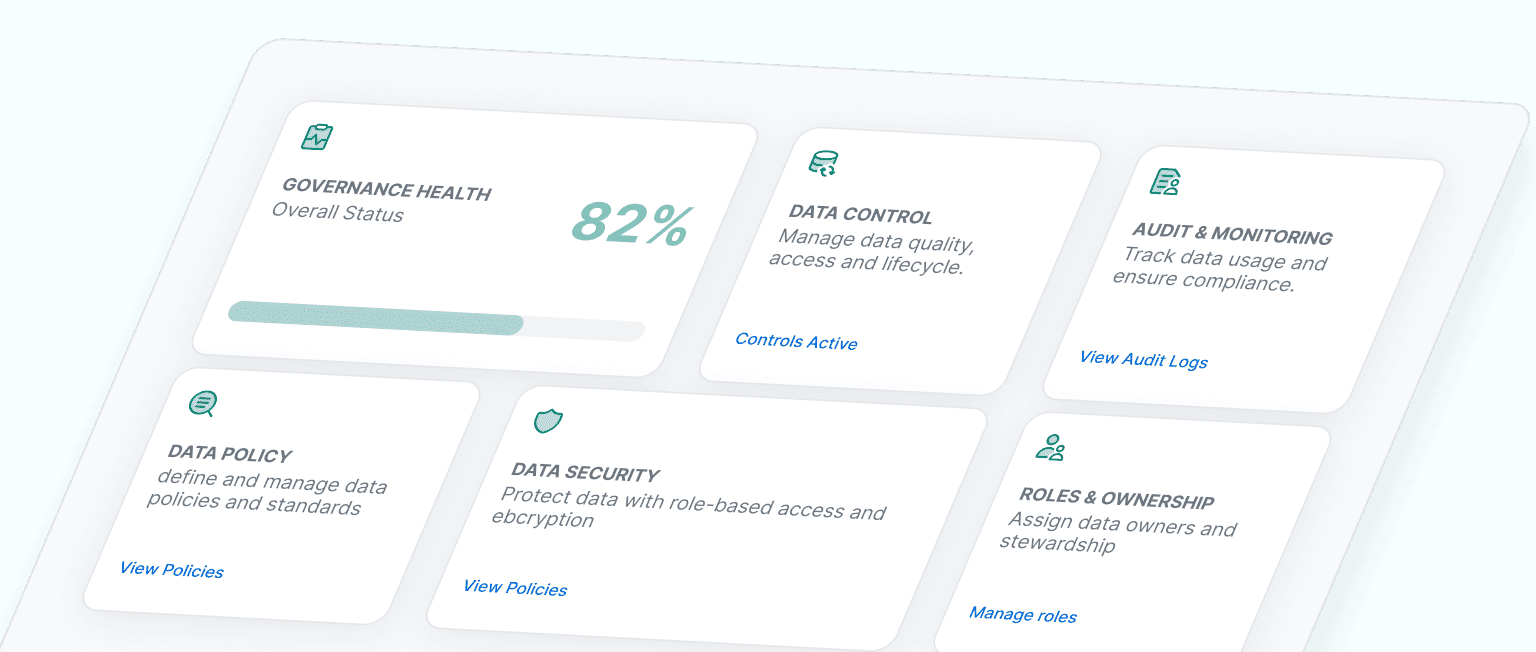

Letting marketing own their reporting is the-most-likely-to-succeed path to compliant and well-governed data for many organisations. To a lot of you in data, this sounds plain wrong. Please bear with me. Not only is it possible, it is easier to achieve than any of the alternatives.
When one of our customers, a major ride-hailing company, first adopted Clarisights as a parallel reporting stack, sitting alongside, rather than on top of, their existing warehouse and dashboards, the marketing team was enthusiastic and the data team was not. Their data people had spent considerable time and effort building out the existing infrastructure. A separate system, owned by marketing, felt like a step away from control rather than toward it. A couple of years later, their position had reversed completely. The data team shared with us that, contrary to what they expected, both compliance and governance had improved.
This is not uncommon - we often see data teams hate the idea initially and do a full 180 on Clarisights after they see the setup in practice. This just shows how hard it is to imagine compliant marketer-owned reporting in a world where marketer-owned reporting usually means spreadsheets.
How the traditional setup fails
The usual way data teams try to ensure data compliance is to centralise all data in the warehouse and build out dashboards for different teams. Requirements are gathered. A data engineering project is scoped. Fivetran pulls data from Google Ads, Meta, and other channels into Snowflake or BigQuery. DBT models transform it into something usable. Tableau or Looker sits on top as the presentation layer. Six to nine months later, marketing gets a dashboard.
At the point of launch, the setup is clean. The metrics are agreed upon. Everything works. It's beautiful!
However, the business moves on. Marketing wants to launch in Germany. They need a dimension that groups campaigns by market so they can track spend and performance by country. A simple thing. For the data team though, creating a new dimension means updating the DBT model, testing the change, deploying it, and making sure nothing downstream breaks. The data team is happy to do it, but they are also handling ten other requests, running their own quarterly planning, and supporting three other business functions. The Germany dimension goes into the backlog.
This is how centralised data teams operate at scale. Projects get resourced heavily at build time and lightly at maintenance time. Requests that once moved quickly now move through quarterly OKR planning. Every change in marketing such as new markets, new product lines, new creative concepts, becomes a data engineering ticket, and the ticket joins a queue.
On top of that, as time passes and historical data accumulates, the dashboards get slower. A report that loaded in fifteen seconds with a year of data loads in a minute with three. Nobody makes the structural improvements that would fix this, because the people who would want to tackle that work have moved on to more interesting problems.
This is a simplification; there are further problems with BI dashboards for marketing reporting - if you are curious, I have written about them here. The point is - over time, the setup becomes unusable for marketers so they start downloading data into spreadsheets to get what they need.
Spreadsheets break compliance
The escape into spreadsheets is understandable and completely predictable. Marketers download attribution data from Tableau, pull performance data directly from Google Ads and Meta, open a spreadsheet, and stitch it together manually. They build their weekly business reviews, track spend against quarterly commitments and do their actual operational reporting this way.
From the point of view of data compliance, however, spreadsheets are the absolute evil. They cannot be compliant by definition.
They are owned by many different marketers doing their own thing. There is no central metric definition, no observability and no way to spot mistakes. When a formula references the wrong column, someone typed B2 instead of C2, the resulting column may still very well receive a number, albeit a totally wrong one and it might be hard to tell. When one marketer defines "conversion" using UTM campaign and another uses UTM source, the two reports produce different numbers for the same underlying reality, and there is no way to tell from the outside which is right or where the discrepancy came from. When someone needs to know who changed a metric definition last Tuesday and why, a spreadsheet shared in a Slack channel is unlikely to offer an answer. There is no audit trail, no version control, no protection against well-meaning edits that break things downstream.
You can't mandate spreadsheets out of existence though. Marketers use them because they need them to steer millions in spend. Telling them not to use them means telling them to fly blind and acquire users inefficiently. Do you want to do that? Probably not.
In effect, the warehouse plus dashboards setup inevitably leads to complete data non-compliance in marketing. We encounter abundant reporting spreadsheets in every organisation with this kind of reporting setup.
How do you get rid of spreadsheets?
To get rid of spreadsheets, you need to give marketers something like spreadsheets but better.
Something that moves at the speed of marketing, gives them the flexibility and control they currently get from spreadsheets, and does not make them wait for a data engineering ticket every time something changes.
But it also has to be something that has audit trails, version control and other advantages of a real data management system.
This is what a full stack marketing reporting platform like Clarisights does. A marketer can create a dimension grouping German campaigns without touching a line of SQL. They can build their own views, define their own filters, and explore the data at the granularity (ad, creative, keyword level) that their optimization work requires. They do not need to wait. They do not need to export. They do not need a spreadsheet!
Metric definitions in the platform are governed centrally. A business user cannot quietly change whether "conversion" is counted from UTM campaign or UTM source, or pick a different column because the formula looked confusing. The guardrails are built in. The result is that everyone who asks "how did Germany perform last week?" gets the same answer, derived from the same definition, with a traceable logic behind it.
The data team wins too?
Interestingly, yes.
The data team can see exactly how data enters the system, how it is modelled, and what every metric definition contains. They can define which dimensions are available, validate that the logic is correct, and lock definitions that need to stay consistent. What they gain is genuine observability into what marketing is doing with data, rather than finding out six months later that three teams have been running parallel spreadsheets that nobody can audit.
There is no contradiction between a tool that gives marketers real flexibility and a tool that gives data people real governance. These are not competing requirements. It just felt like it because the tools typically used are not a good fit for this space.
A vertically integrated marketing reporting platform is far more likely to produce genuine compliance simply because marketers will actually use it, which means they will stay out of spreadsheets, which is the only way compliance becomes possible in the first place.
Fine, now what? Another year-long BI project?
Surprisingly, not. A platform like Clarisights can be live and in use within two weeks. But that's the story for next time.
Read more on similar topics
See Clarisights in action
Curious to see how leading enterprise marketing teams go from questions to insights in minutes?
Book some time with us.