
In the last piece, I wrote about why BI dashboards are a bad fit for marketing reporting. The short version: the stack was not built for marketing data, granularity is prohibitively expensive, and the tooling cannot move at the speed of marketing strategy. The conclusion was that companies tend to settle for campaign-level data in their dashboards, and marketers tend to find a way around it.
This piece is about what happens next. The escape into spreadsheets is not just a workaround, it is where the real silo problem begins.
Trying to fix data silos makes them worse
Here is the paradox. Data teams doing their best to solve fragmented marketing reporting will, almost inevitably, make it more fragmented. The path goes like this: consolidate data into a warehouse, surface it through a BI dashboard, call it the source of truth. The problem is that the source of truth is built at the wrong granularity for marketing, does not contain the planning context marketers need, and cannot evolve quickly enough to follow shifting priorities.The central data team becomes the bottleneck for any changes, updates, or views that each of the marketing teams require across regions and you very quickly reach a stage where there is no way you can turn around the business requests fast enough, and start running a project-based approach, where you start grouping requests together and turn this into quarterly goals. Marketers can’t wait that long so they stop using the dashboards for many of their use-cases.
They do not abandon reporting of course, they just rebuild it themselves in spreadsheets. And every team that does this creates a new silo.
The centralised dashboard becomes an executive artefact that leadership checks for top-line numbers, while the actual operational reporting for marketing happens somewhere else entirely, outside the governance of anyone in data.
What marketing reporting looks like in reality
To understand why, it helps to observe how marketing teams work.
Most marketing teams operate on quarterly priorities, tracked weekly. They call these WBRs - weekly business reviews. A WBR is a structured review of performance against the plan: what did we commit to this quarter, and how are we tracking?
The plan contains specifics. We are going to spend 15% more in this market. We are going to grow this product category by 10%. We have channel-level commitments attached to each objective. Every week, the team needs to reconcile actuals against those commitments. What did I spend in the category I said I would grow? What did I spend in the channels I committed to scaling?
Those goals and budgets are not in Tableau. They change every quarter, differ by sub-team and are just not the kind of thing that gets implemented in a BI dashboard. Which means the WBR has to be built in a spreadsheet too, or at minimum reconciled against one.
The data for the WBR itself is also not all in Tableau. This is the granularity problem - marketers want to see granular data from platforms (Google Ads, Meta, TikTok), while BI tools would at best offer campaign level. But Tableau still matters, because it holds the internal revenue and attribution data. So the workflow looks like this: go to Tableau, download internal attribution data, you can’t get that anywhere else. Open a spreadsheet. Try to map it against what came from Facebook. Try to reconcile the two views into something coherent. Build the WBR from that.
This is not an edge case. This is the standard operating procedure for a well-run marketing team.
The silo is inside marketing
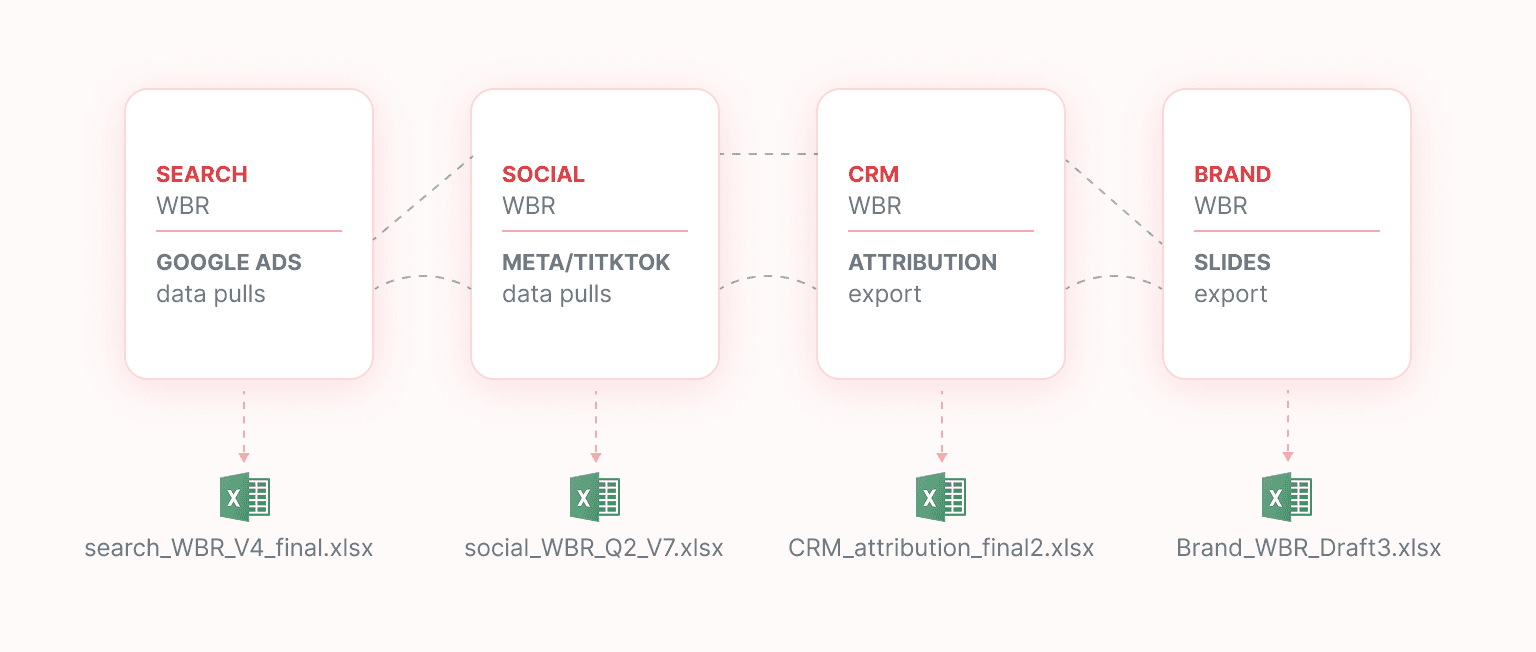
Now multiply this by the number of marketing sub-teams in a typical organisation. Search has a WBR. Social has a WBR. CRM has one. Brand might have one. Each team has different objectives, different KPIs, different definitions of success. Each builds its own review process around its own slice of data, in its own spreadsheets, in its own format. Some teams take the spreadsheet and turn it into slides for the weekly meeting. The formats diverge. The methodologies diverge. The metric definitions diverge.
This is what data silos in marketing look like. Not a single fragmentation between the warehouse and the business, but a fractal one: fragmented by team, fragmented by format, fragmented by the specific way each function has decided to answer the question "how are we doing?"
The consequence is inefficiency, mistakes, and, importantly, lost insight. When a product category starts performing better than expected, it almost never happens in just one channel. When the Search team notices that a category is outperforming, the Social team is almost certainly sitting on the same signal. The right response - scaling spend, adjusting creative, shifting budget toward what is working - requires knowing what is happening across the full system. But that cross-channel view does not exist, because everyone has their own reporting.
On top of this, different people in the same organisation are making decisions from different data. The performance marketer on the Search team is optimising on numbers pulled directly from Google Ads. Their Head of Marketing is looking at warehouse data, aggregated to channel level. Management is reviewing a version of performance that has been modelled, deduplicated, and possibly lagged by days. None of these people are wrong, but they are not looking at the same thing, and they often do not know it.
The wrong starting point
This is what happens when you start from the solution rather than the problem.
"We have Tableau. Let's give it to marketing" is an understandable instinct. It’s a tool that works for finance, for product, for the C-suite. Why would marketing be different?
But marketing is different. If you approached this as a product person doing proper discovery, if you sat with a SEM marketer or a Social manager and watched how they build their WBR, you would not come out the other end proposing a BI dashboard. Everything described above: the plan living in a spreadsheet, the manual reconciliation across platforms and warehouse, the team-level KPI fragmentation, the pace of strategic change - none of it points toward a BI dashboard.
What would actually fix it
The solution is not to force marketers back into a dashboard they have already voted against with their feet. It is to offer something that reflects how marketing works.
That means starting with governed, granular data (ad / creative / keyword level, not campaign level) that brings together platform data and internal revenue data in one place, without the cost explosion that kills most BI setups at that granularity. It means building a context layer that understands metric definitions by team, by channel, by market, so that "conversion" means what it should mean for whoever is asking.
Critically, it means making room for the plan. Goals, budgets, quarterly priorities, WBR notes — these need to live alongside the performance data, not in a separate spreadsheet that someone reconciles once a week. When the plan and the actuals are in the same system, the WBR stops being an export-and-stitch exercise and becomes something a marketer can use efficiently.
And it means giving marketers the flexibility to build their own views and explore the data. It’s not possible for a data analyst to build all of the views to answer all the questions marketers from different teams might have - and this should not be the goal. The goal is shared insight with flexible presentation: consistent underlying data and definitions, with each function able to surface the cut of it they care about.
A fair objection at this point: wouldn't a dedicated marketing reporting surface just recreate the original silo between the warehouse and the business? No - the point is to have fully auditable pipelines and metric definitions, and bidirectional sync with the warehouse where it is needed: for experiment data, for MMM inputs, for anything that requires the warehouse as a system of record. This is not about disconnecting marketing from the data stack. It is about giving marketing a reporting surface they can use happily, while keeping data governance intact for the data team. The historical tension between the two resulted from poor design, not from some inherent incompatibility.
How do we know all of this? Well, this is how Clarisights was born - the tool was first built by marketers trying to solve their own reporting problems. Then other marketers saw it and wanted it too. If you want to explore what this could do for your team - please, reach out to us.
Read more on similar topics
See Clarisights in action
Curious to see how leading enterprise marketing teams go from questions to insights in minutes?
Book some time with us.